
Three Expensive Inefficiencies You Don't See Until It's Too Late
Remodeling is a capital decision, not a creative hobby. Before you commit to managing your own interior architecture project, the question isn't whether you can do it. The question is whether the total cost of doing it yourself exceeds what you'd pay a professional. When you calculate the real numbers, self-managing home renovation is one of the most expensive decisions you’ll ever make.

Cost #1: The Value of Your Time
Your time has an hourly value. If you're a business owner, executive, or high-performing professional, that value is substantial. Every hour you spend researching contractors, managing timelines, sourcing materials, troubleshooting delays, and second-guessing selections is an hour not spent on income-producing work, strategic thinking, or time with family.
For example, if you're billing $300/hour and spend 180 hours managing your renovation, that's $54,000 in opportunity cost. If the average designer charges $15,000 to design and manage your project, it's cheaper to hire the designer so you can do your job. These numbers are hypothetical and ballpark, but it's something to think about. When your personal earning power exceeds the cost of professional oversight, self-managing becomes economically inefficient. You're trading high-value time for low-value tasks.
What You Get When You Hire Us
You get your time back. We handle contractor research, timeline management, material sourcing, and every project decision. You stay focused on your work and family while we execute the renovation. No phone calls with subs, no trips to tile showrooms, no midnight decisions about grout color, just progress updates and a finished project.
Cost #2: The Learning Curve Tax
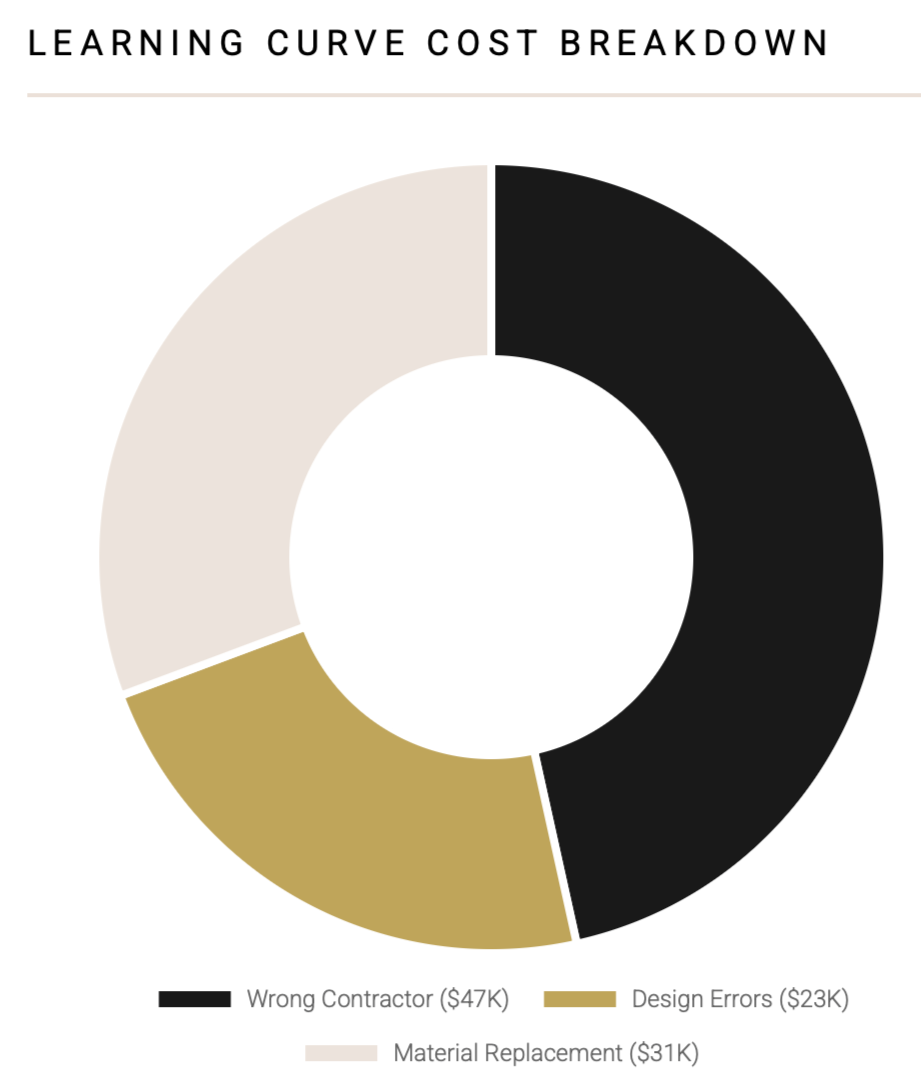
There is a steep financial cost to inexperience. Every mistake in a renovation has a price tag:
Hiring the wrong contractor: $47,000 in remediation, legal fees, and correcting work.
Design errors: $23,000 to fix wrong-scale furniture, spatial flow issues, or finish selections.
Material replacement: $31,000 for repainting, replacing countertops, or re-tiling mistakes.
Total learning curve cost: $50,000–$150,000. Professionals absorb this across hundreds of projects, homeowners absorb it all at once.
What You Get When You Hire Us
We eliminate the learning curve tax. Our vetted contractor relationships, proven design systems, and project management catch costly mistakes before they happen. No remediation, no rework, no waste—just a project executed correctly the first time.
Cost #3: Inefficiency and Lost Opportunity
The most expensive mistakes are the ones you don't see. Without professional design oversight, homeowners are forced into strategic missteps that quietly erode their home's value and functionality:
Was an addition necessary, or could smarter space planning have solved the problem for a fraction of the cost?
Could the kitchen layout have increased resale value by $100,000?
Was the square footage optimized for flow and function, or did you build unnecessary space that now costs you in property taxes and maintenance?
Did you choose furniture that maximizes the room's potential, or are you living with pieces that make the space feel smaller and less functional?
These inefficiencies rarely look like obvious errors. They present as subtle disappointments: a kitchen that doesn't quite work, rooms that feel cramped despite being large, spaces that never get used. But their financial impact is real. Poor space planning can reduce resale value by 15-20%. Inefficient layouts increase long-term maintenance costs. Missed opportunities compound over years of living in a home that doesn't function as well as it could.
What You Get When You Hire Us
We optimize every decision for long-term value. Our space planning eliminates unnecessary square footage, maximizes resale potential, and ensures every room functions at its highest level. You don't just get a beautiful space, you get strategic design that protects and increases your investment.
The Total Cost Calculation
Add it up:
Opportunity cost of your time: $10,000 - $60,000
Learning curve mistakes: $50,000 - $150,000
Strategic inefficiencies: $50,000 - $200,000 in lost equity and functionality
Total hidden cost: $110,000 - $410,000
The Bottom Line
Remodeling is a capital allocation decision. The question isn't whether you can manage it yourself. The question is whether the total cost of mistakes, inefficiencies, and lost time exceeds what you'd pay for professional expertise.
Ask yourself three questions: Can you afford to lose $54,000 in billable time? Can you absorb $100,000 in learning curve costs? Can you risk reducing your home's value by 20%?
Because the most expensive renovation mistake isn't overspending on design services. It's underestimating what self-managing actually costs you.